After the Vietnam War victory in 1975, Vietnam was
in a process of rebuilding. People everywhere were stricken with poverty. Back
then, only a select few could afford to buy a motorcycle. The most prominent
motorcycle in Vietnam in the 1980s had to be the Honda SS50 (50cc) – commonly
referred to as the Honda 67 because they were first manufactured in 1967. The
SS50 was the motorcycle to have at that time and was considered a status symbol
among the general population. “Players” (people who could afford to buy this
motorcycle and modify it) held street races among themselves to see who had the
best “67” and skills.
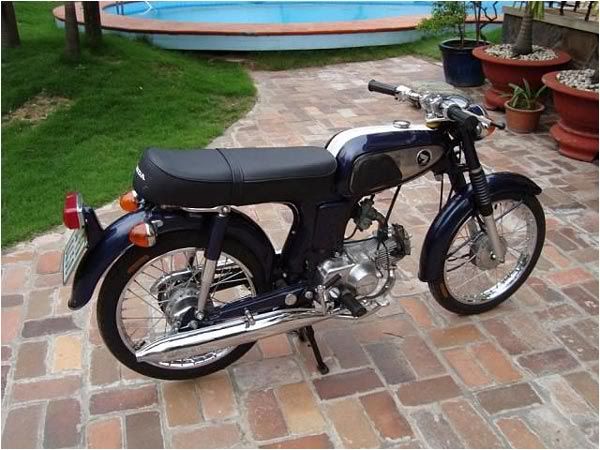 |
| Honda SS50. Courtesy of Honda 67 Việt Nam. |
After many years of dominance, the SS50 was
dethroned by the Suzuki Sport 50 (50cc). This two-stroke monster could actually
reach 120 km/h if “racers” who knew what they were doing put enough money in
it. But its reign was short-lived because the tiny engine could not last long
with such heavy modifications. The bright side is that they were very cheap to
buy second-hand so more people could actually afford them later on.
 |
| Suzuki Sport 50. Courtesy of Báo Mới. |
Then the Kawasaki Cosmo 105cc came into Vietnam from
Thailand and completely destroyed the competition. The Cosmo had a much
sportier look compared to the Honda SS50 or the Suzuki Sport and made a much
better sound as well. If properly modified, it could reach speeds of 120 to 130
km/h. The Cosmo was favoured in the late-1980s, but in 1990 came the Suzuki
Crystal 110cc which, once again, raised the bar. The Crystal was so strong that
even with two people sitting on it, if the rider is not careful it would do a
wheelie in first gear and throw the passenger off.
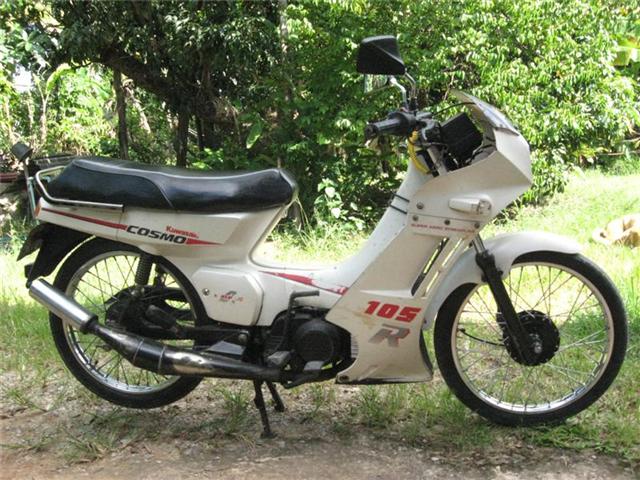 |
| Kawasaki Cosmo. Courtesy of Thai Scooter. |
 |
| Suzuki Crystal. Courtesy of 5 Giây. |
In this period, the Crystal, especially the “Seven
Star” variant, ruled the streets of Ho Chi Minh City and Hanoi and had a place
in the hearts of all Vietnamese youths. Riding a Crystal with a girl as the
passenger was what every high school and university students at that time
wanted. If you rode a “C”, you had nothing and no one to fear. Shift down to
first gear and accelerate and the people on the streets would all have to make
way for you (and curse under their breath). Although speed-wise, it could not
compete with the Honda Nova Dash (another two-stroke monster), but it was more
expensive and elegant than the “Nova”. The “Nova” had a thuggish look that put
off the girls and especially their parents. In the early-1990s, as the economy
gets better and more people could afford motorcycles, four-stroke models were
imported from Thailand. Honda became a household name with the Cub 50cc, Chaly
50cc and Dream II 100cc. Four-stroke motorcycles were heavily favoured over the
two-strokes because of their reliability and fuel economy, especially the Dream
II which was the new status symbol, costing roughly $1500 at a time when most
households in the country did not make $500 a year. Coupled with the fact that
criminals could finally get their hands on cheap throwaway two-stroke
motorcycles and use them to terrorize the streets, the Crystals and Novas were
seen as bad influence. But for racers, they were still gods among men compared
to the tame four-strokes. The Suzuki Crystal can reach between 140 to 150 km/h
when modified extensively and with a lighter rider, but because it was so light
(less than 100 kg), its wind resistance was terrible. This was a major problem
for anyone who wanted to race a Crystal because back then there was no such
thing as motorcycling protective clothing or helmets in Vietnam so to fall off
the motorcycle at those speeds would mean a sure death. Eventually, in 1994,
the Suzuki Crystal and Honda Nova became less popular with racers even though
later versions were more powerful and faster.
 |
| Honda Dream II. Courtesy of VnExpress. |
The first racing-replica from Honda came into late
1994, the Honda NSR 150 (150cc). This motorcycle cost a fortune and was vastly
more powerful than its competition. Ironically, that was exactly why it was not
received favourably. It had no competition apart from itself and there were no
point in racing it since victory was guaranteed. The NSR lived in obscurity for
a while until the überexclusive Italian Cagiva Mito (125cc) arrived and
“killed” it.
 |
| Honda NSR 150. Courtesy of Zing. |
 |
| Cagiva Mito SP525. Courtesy of VnExpress. |
But these racing replicas were not popular because they had no
competition and were too expensive to run and maintain. Eventually, in 1995,
the Suzuki Crystal reclaimed its throne as the most popular racing motorcycle
in Vietnam. This was mostly because the 1995 version had a face-lift and
featured a more aggressive front end (for that time). Its engine also remained
the same so this newer Crystal had the same top speed as the older ones. This
time, however, most garages focused on tuning for acceleration. If the rider is
not used to its power, even in third gear it can still surge ahead unexpectedly
and pull a power wheelie and throw them off. Even people with experience often
find themselves sliding onto the back seat if they are not careful. Those who
managed to hang on close their eyes and pray for the best.
The Suzuki Crystal was most popular in black because it was not available in
many colours to begin with and also because black was the most unassuming
colour and least likely to attract attention. 1996 was the end for the Crystal’s
reign because another Suzuki was introduced into Vietnam: the RG Sport 110cc.
This new motorcycle was more high-tech, faster and sportier than the dethroned
Crystal. It also cost a lot more, even more than the 1996 Honda Dream II which
cost approximately $2500, and most importers sold it for more than $3000. At
the same time, Yamaha released the 110SS (also 110cc to compete with the RG
Sport but it was not as well-known.
 |
| Suzuki RG Sport 110. Courtesy of BikePics. |
The earliest organized motorcycle races were held in Phú Thọ Province, Biên
Hòa City and Cần Thơ Province. Suzuki and Yamaha were the two most competitive
manufacturers. Even though it dominated the street racing scene, on the tracks,
the 110SS gave the RG Sport a run for its money. As time went by, it was clear
that the Yamaha was less reliable than the Suzuki. As a result, independent
garages that ran the RG Sport won most races while only some veteran racers on
the 110SS could salvage a few wins with technical help from Yamaha.
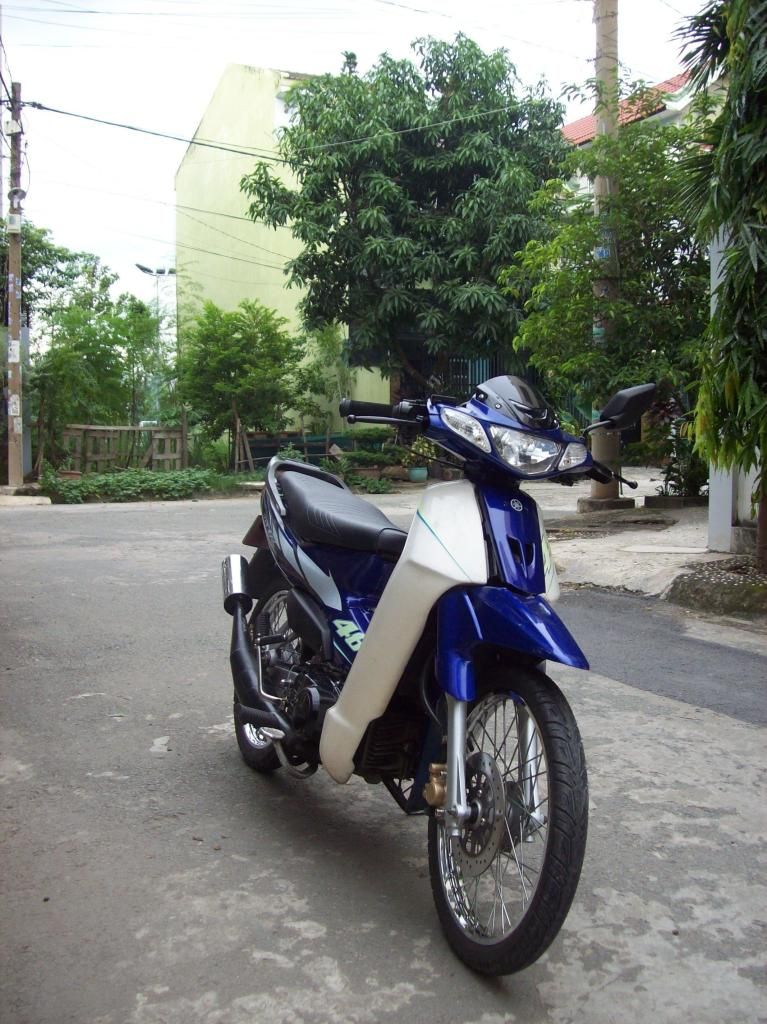 |
| Yamaha 110SS. Courtesy of 5 Giây. |
There is a good reason why Suzuki has garnered a huge following in
Vietnam. Although the Vietnamese motorcycle market is now dominated by Honda
and Yamaha, some still maintain that Suzuki makes the most underrated
motorcycles. With the proper modifications and tuned for maximum speed, the RG
Sport can reach 160 km/h. If tuned for acceleration, it will take a heavy rider
(60-65 kg) to keep it from pulling wheelies in every gear. This motorcycle was
also much better at cornering than its predecessor. The frame of the RG Sport
was sturdy and felt very solid, its wheels were big and the tyres were
higher-quality than those on the Crystal. It was so stable that a 40-degree
lean angle was possible. If a rider attempts this on the Crystal, they will surely
crash.
The RG Sport was so favoured that everything associated with it was
inflated. Decals and vinyls for this motorcycle cost about $25 – an absurd
price at that time. In Ho Chi Minh City, numerous motorcycle accessories stores
popped up and made fortunes by importing parts (pistons, air filters,
bodyworks, big bore kits etc.) from Thailand, Indonesia and Malaysia.
In 1997, a four-stroke scooter arrived on the streets of Ho Chi Minh
City: the Honda Spacy 125cc. It was purely a vehicle for the bourgeoisie. If
you had a Spacy, you were upper-class. This was because it was much more
elegant, easier to use and, generally speaking, cost a lot more than any motorcycle that was introduced before it. The
Spacy gave Vietnamese motorcyclists a new perspective on motorcycle comfort and
luxury, speed-wise it was no match for the two-strokes, but it was not fair to
compare two different types of motorcycles made for different purposes. The
only other mass-introduced motorcycle to rival the Spacy in price ($4500) was
the new Suzuki RGV 120 (120cc). These two newcomers also helped the habit of
Vietnamese from calculating prices of imported in 24K gold to using United
States Dollar. This habit has persisted until today and is unlikely to go away
anytime soon.
 |
| Honda Spacy 125. Courtesy of Mua Bán Xe Máy. |
 |
| Suzuki RGV 120. Courtesy of Diễn Đàn Lê Quý Đôn. |
After extensive modifications, the RGV 120 will reach more than 170 km/h,
mostly 171-173 km/h. Some garages tune their motorcycles to get a maximum speed
record will compromise the integrity of the engine and risk an engine failure to get to
180 km/h. However, these speeds can only be attained at the hands of an
experienced and somewhat “mental” rider.
Towards the turn of the century, many more two-stroke as well as
four-stroke motorcycles are introduced into Vietnam as the economy improves.
Although all of them were fast for their times, the law has begun to crack down
on illegal street racing and motorcycles have become a dominant form of
transport in Vietnam, “racy” motorcycles such as the Suzuki Akira 110cc, the
Honda Nova Dash 125cc or the Suzuki Stinger 120cc did not see much action.

holy shit, this is such a great writing! thanks for the info and street history.
ReplyDeleteThanks for sharing this great information... Suzy rider from Malay land
ReplyDelete