This blog is dedicated to things related to Vietnam that ARE NOT usually discussed. If you want to see many different aspects of Vietnam, read on. Enjoy!

Thursday, 30 May 2013

The Rolls-Royce Whisperer

The Range Rover Autobiography Ultimate parking in the center of Ho Chi Minh City signals that its owner is hanging out somewhere in the area. His year of birth (1978) is just about the only bit of his personal information M. (his initial) agreed to be publicized. For such a young and successful entrepreneur, this man is surprisingly secretive. He had successfully evaded the attention of the Vietnamese media for years although his penchant for luxury is well-known in the business world. He is also the man who brought Roll-Royce into Vietnam.
M.'s Range Rover Autobiography Ultimate Edition. Courtesy of AutoTV.
M.'s secrecy is understandable. In a country where the median income per capita is a meager $1400 per year, a car costing from $500 thousand to $800 thousand (second-hand) and $1.2 million to $1.7 million brand new will draw much unwanted attention  wherever it goes. Many have used this to their advantage: Ms. Dương Thị Bạch Diệp, a real estate developer, has become extraordinarily famous overnight because she imported a brand-new Rolls-Royce Phantom in 2008. The same can be said for Mr. Lê Ân who was not known outside of his hometown of Vũng Tàu until he bought his own Phantom.
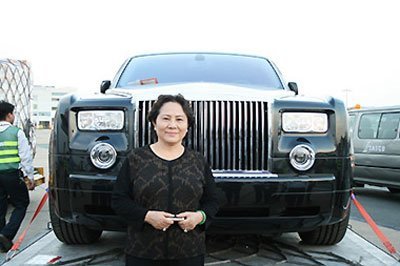
Ms. Dương Thị Bạch Diệp and her Phantom. Courtesy of VietnamNet.
Mr. Lê Ân and his Phantom. Courtesy of VietnamNet
There are a total of 56 Phantoms in Vietnam but only one of them (Ms. Diệp's) was imported straight from the factory. But if we count other Rolls-Royces, the total number would almost double to 97. Apart from the 56 Phantom saloons, there are also six Drophead Coupes, two Phantom Coupes, 31 Ghosts and two antique cars from the Vietnam War. Even more astonishing, of the 56 Phantoms, six of them are the ultra-exclusive "Year of The Dragon" Edition of which there are only 33 in the world.
A Phantom Drophead Coupe. Courtesy of VnExpress.
A Phantom "Year of The Dragon" Edition. Courtesy of VnExpress.
It can be concluded that, judging on the overall economy of Vietnam, the country's big spenders have invested an incredibly large amount of money in the double-R brand. But most of them are doing it the right way. A business partner of M. simply known as "Kar" chimed in that Rolls-Royces are status symbols not just in Vietnam but everywhere in the world, but the Vietnamese buyers are wrong in thinking that just owning a Phantom makes them special. The real special cars are those that were specified by the customers themselves. Of the 97 in Vietnam, sadly only one or two or actually built to their owners' specifications.
"So basically, many of them have disregarded the company's most basic principle: treating their customers as royalties. You can have almost anything you want on a Phantom or a Ghost done according to your taste, but instead you go and buy other people's taste," he said frankly. "So are you really kings at all?"

While M. sat silent and observed the conversation, "Kar" continued with his passion for Rolls-Royce. "If I can pay, and I wish I can, my Phantom is going to put the ones in the Sultan of Brunei's garage to shame," he laughed. "I really love the way they even take your feet measurements to make sure you don't get cramped while sitting. That's why I disagree with people who buy second-hand Rolls-Royces."

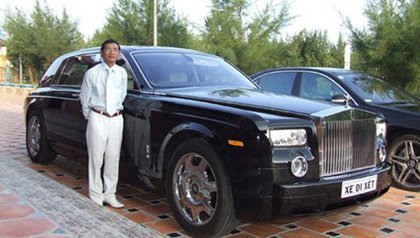
M.'s personal Phantom EWB (Extended Long Wheelbase) is the first of its kind in Vietnam. The most special object on this car is a clock made by Corum of Switzerland that has M.'s initials engraved on the dials. The clock can also be unattached from the center console of the Phantom and worn as a watch. He spoke of his plan to bring the real Rolls-Royce into Vietnam and how it had always been his dream to put Vietnam on the luxury map of the world. "I want one thing and one thing only: to bring the absolute perfection of the greatest luxury carmaker to the Vietnamese people," he said proudly of his achievements in becoming the brand's representative and opening their first showroom in Hanoi. His new company, Regal Motor Cars, will also be the official dealer of Rolls-Royce when the showroom is opened in September 2013. M. is right to be proud of his victory, he had beaten Euro Auto - the official dealer of Rolls-Royce parent company BMW - and many other prominent Vietnamese companies to secure the deal.
M's Phantom EWB. Courtesy of VnExpress.
M. has been successful so far in his career. Not only in being recognized by Rolls-Royce but also in spreading his wealth around for the good of the community. He is a philanthropist but does not call himself a giver. "I try to do what I can," he said. "I just don't want people to tell me what to do." M. has also been very successful in polishing his name with garnering much attention. Near the end of 2012, rumors that a "big player" is about to bring Rolls-Royce into Vietnam started to surface. And when Regal Motor Cars was announced of the official dealer, everybody apart from insiders were taken by surprise. Surely with his "stealthy is healthy" business ethics, M. will keep winning.

*Updated: Since Rolls-Royce has recently opened their showroom, M.'s identity no longer needs to be concealed. He is Đoàn Hiếu Minh, Chairman of the Board of Regal Motor Cars.

"Vertu"ally Peerless

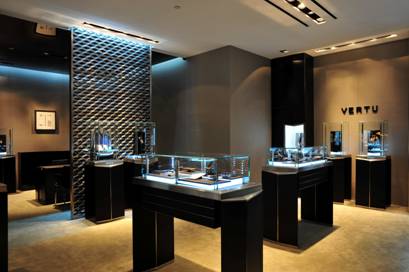
The "One and Three" design principle that Vertu - the world's leading luxury mobile phone manufacturer - implemented in the creation of its new boutique at the Rex Hotel in Ho Chi Minh City is deep-rooted in Vietnamese tradition. "One" stands for nhất đạo which means to work in accordance to the natural flow of things and not forcing success, thus becoming one with nature. If they continue to do what they do best, it is only natural for them to keep winning. "Three" stands for tam tài which means there are three keys to success: time, place and humanity. Not only are they important in business, they have played a vital role in all aspects of Vietnamese life.
Layout model of the Vertu Boutique in the Rex Hotel. Courtesy of Dân Trí.
But "One and Three" is not the company's only principle when operating in Vietnam. Vertu makes a very visible effort to showcase a harmony between nature and man through its products: diamonds, titanium and gold combined by the hands of master workers to create not mere mobile phones but beautiful sculptures.

For the new boutique, even the company's logo served as an inspiration. Its vivid shade of gold is presented on every single piece of furniture and display piece in the store. Platinum, not silver, is used sparingly to give the interior a classy look and feel so that the customers, or anyone who visits the boutique, are not taken aback by the seemingly outrageous display of luxury. The reception desk is billeted from a single block of steel and half of it wrapped in French-made black leather, the other is platinum-plated. The walls are painted in black and polished so that the interior of the boutique is effectively a giant mirror box. This was done to create the impression that it is packed with beautiful phones because in reality, the boutique holds only twenty-four pieces, the most affordable of which already commands in excess of $10000 and on the other end of the affordability spectrum is a piece that has a six-figure price tag.
The sales area. Courtesy of Saigon News.
By not carrying many pieces in its inventory, the boutique has an advantage that is not immediately recognizable from the outside. It is spacious. With a total display area of 150 square meters, the Rex boutique easily meets the standard for Vertu stores all around the world. It is also a prime location right in the heart of Ho Chi Minh City's shopping district. At Vertu, it is no longer sufficient to merely place display cases around the store and leave potential customers to wander their way around. Their artful displays evokes a feeling of lasting heritage and the connection between Renaissance Europe and Vertu's vision of the future. It is rumored that for this particular store, the in-house designers created it on paper themselves and handed it over to some of the best architects in the United Kingdom to bring it to life.

Ms. Trần Ngọc Tuyến, Head of the Marketing Department for Vertu in Vietnam shared her thoughts on what this boutique means to Vertu and Vietnam. "This is certainly not the biggest store in Vietnam, but it is the grandest. Setting up this fourth boutique in the country signals that Vertu believes in this market and will maintain its powerful presence."
The Rex Arcade (the Vertu Boutique lies deep inside). Courtesy of  Tin Mới.
Adjacent to the sales area is an area designated as "Private". Here, customers can relax on luxurious sofas and entertain themselves with various forms of media. Large transactions, personal requests and special orders will also be made carried out in this area - separated from the rest of the store by a thick, black wall of stainless steel and acrylic - to keep them away from curious eyes and ears.

The last area of the store is the Care Zone which takes care of problems any problem that appears under warranty. The staff looking after these top-of-the-line mobile phones are all trained in Europe and operates under strict international guidelines. Before this Care Zone was opened, any problem concerning warranty meant that the phone had to be shipped to Shanghai, now they can be dealt with immediately in Vietnam. This means customers can finally get their phone checked up and returned much faster.

The Vertu logo. Courtesy of Lux Mobi Tech.
One would assume that after more than 15 years as the world's leading luxury mobile phone maker, Vertu would have nothing more to prove. On the contrary, they have maintained focus and steered ahead on their predetermined path. To inspire customers as well as provide impeccable service has been the company's ideology from day one. Now, they have nowhere else to go but forward.

A Colonel and His Trophies

Colonel insignia in the Vietnamese Police Force. Courtesy of  Wikipedia.
In the early-1990s, Dương Văn Khánh, also known as Khánh "White", was known to be a well-mannered but terrifyingly cruel trùm (the Vietnamese equivalent to a don). Under the guise of CEO of the Porter Association of Đông Xuân market in Hanoi, he commanded approximately 500 "soldiers", all of whom had a long criminal record. What was so terrifying about Khánh was that not only does he gives orders to his henchmen, he also actively participates in criminal activities himself. On the 22nd of May 1996, his gang carried a plan to rob the wealthy residents of 71E and 71D Kim Mã Street. Even though it was a successful operation, Khánh was arrested two days later. During the subsequent interrogations, he gladly admitted to all his crimes petty crimes and his involvement in the robbery on Kim Mã Street. However, when the questions came round to the murder of a person called Đạt (real name Nguyễn Đức Thắng) on 44 Hàng Chiểu Street that was committed earlier and for which he was a suspect, Khánh vehemently denied everything that he was accused of. Because he was very cunning, Khánh understood that his arrest for the robbery on Kim Mã Street was actually of little value because the penalties were "laughable". What the investigators were really after was his confession that he killed Mr. Đạt himself.
Khánh "White". Courtesy of Công An.
Having examined the evidence carefully over and over, the investigators came to the conclusion that the primary suspect Vũ Quốc Dũng - one of Khánh many extremely loyal henchmen - could not have stabbed Mr. Đạt three times: once in the thigh, once in the back and once in the left shoulder (the fatal stab) because Dũng was standing right in front of Mr. Đạt. It had to have been someone else. And not a single investigator doubted Khánh was the perpetrator of the crime because they knew Khánh was left-handed.

But how did they prove Khánh was left-handed? He was very adept at using his right hand to write and also used chopsticks to eat with his right hand. This presented a huge obstacle to overcome. For one month, the investigation was stagnant. Colonel Phạm Văn Tám, Chief of Section 8 in the Ministry of Public Security, observed him closely for every single day of the week and every week of the month. One day he realized Khánh was heavily addicted to cigarettes and had very good reflexes. From then onwards, during each interrogation, the Colonel would light a cigarette to only halfway and blow the smoke in Khánh's face. On the supposed last interrogation before Khánh was released, the Colonel simply asked "Do you smoke?" and Khánh answered as if he had been waiting his whole life to hear this question "Yes, sir!" After smoking several cigarettes, the Colonel threw on at Khánh and the criminal caught it instinctively with his left hand. Colonel Tám smile because he had finally captured an elusive nemesis and asked politely "Tell me again, are you right- or left-handed?" The murderer froze in his chair, his face as white as a corpse, and simply mumbled "So redundant." Thus a cunning, merciless and cruel criminal mastermind in Vietnam was handed the death penalty at last.

In the operation to bring down Năm Cam - the worst and most influential trùm Vietnam has ever seen - Colonel Phạm Văn Tám was tasked with investigating the murder of Mr. Hồ Phước Hưng and Sergeant Phan Lê Sơn of the Ho Chi Minh City Police Department at Cẩm Chỉ restaurant in district One on the 27th January 2000. While examining the victims' bodies, the Colonel also called for the arrested criminals in the case to have weapon identification sessions, interrogated them extensively and tested their claims against forensic evidence. The weapons were all large cleavers and machetes so it was not easy to identify which weapon was used by whom and against whom. Without these evidence, it was impossible to catch the "big fish" in the case - Thọ "Captain", a loyal hitman working for Năm Cam. Eventually, Colonel Tám figured out something Thọ has been hiding: a "friendly fire" injury he sustained while carrying out the murders. With this injury and the testimony of Thọ's henchmen, the Colonel and his team were finally able to connect each injury on the victim's bodies to a specific weapon and determined who struck the fatal blows. In the end, instead of being charged with Disturbing the Peace, Thọ and 24 other gang members received six different charges for criminal offense, three of which were the death penalty for Nguyễn Hữu Thịnh, Phạm Văn Minh and Hồ Thanh Tùng.
Thọ "Captain". Courtesy of Việt Báo.
At the end of 1998, Colonel Phạm Văn Tám was assigned the task of investigating the largest heroin trading ring in Vietnam at that time which was led by Nguyễn Đức Lượng. He and his team managed to accomplish their mission in just six months. The main lead in the case was Bùi Hữu Tài, a Most Wanted criminal in Melbourne for kidnapping and murder. February 1998, Tài came back to Vietnam under the name Vũ Mạnh Cường. Colonel Tám caught wind of this and personally searched his residence. Suddenly, a woman named Nguyễn Thị Hoa appeared at the door and after a short conversation, the Colonel had a hunch she was a prime figure in the heroin ring of Nguyễn Đức Lượng. After searching Hoa's home, the Colonel and his team uncovered evidences of a recent drug deal. It turned out Hoa's family has been selling heroin for years and even though she was arrested, the fearless woman was sure that her relatives would get her out.
Nguyễn Đức Lượng. Courtesy of Công An.
Unfortunately for her, Colonel Tám was a man of great integrity and was impossible to bribe. Because she was pregnant, Hoa avoided the death penalty and faced life imprisonment. The Colonel instructed his officers to help her give birth and take care of her newborn child. As he had hoped, the once impenetrable woman softened and helped Colonel Tám bring down Lượng.

As for Tài, he refused to cooperate when arrested and for months, the investigator could not get him to shed light on Lượng's criminal activities. Colonel Tám studied the criminal carefully from his hobbies to his taste in music. He even learned English to occasionally converse with Tài in hope that he would open up when speaking in a language not many of the investigators were fluent in. Slowly but surely, the Colonel won him over. During an interrogation, Tài said sincerely: "I'll answer you. I respect you. Melbourne police? Never." With confessions from Tài and Hoa, Nguyễn Đức Lượng and his entire operation were arrested in 2002. The investigators confiscated 108 heroin bricks and 205.5 kg of drugs - both record numbers in Vietnam.
Officers searching for drugs on Lượng's farm. Courtesy of Công An.
Above were some of the most famous cases that Colonel Phạm Văn Tám has solved in his career. Thanks to the effort of people like the Colonel and his colleagues, Vietnam has seen significantly less criminal activities in recent years.

*: Because Colonel Phạm Văn Tám is an active member of the Vietnamese Ministry of Public Security, his identity (facial features and personal details) cannot be fully disclosed to the public. It is unknown whether Phạm Văn Tám is his real name or not.

Wednesday, 29 May 2013

Riders on The Storm


The heyday of two-stroke motorcycles and their reckless illegal street racers may have passed in Vietnam but their stories are still widely told. Vietnamese have a special term for people who race motorcycle, either illegally or legally, for a living: nài. After a motorcycle has received all the latest and greatest modifications the head mechanic and his garage could get their hands on and after they have tuned it to the best of their abilities, it is up to the rider to extract the motorcycle’s maximum potential. In those days, a rider’s reflex and recklessness defined his success.

A motorcycle garage. Courtesy of VnExpress.
People do not call a rider nài just because he can jump on a motorcycle and run it until the engine explodes. Those are only pawns for the garages to test the limits of their motorcycle. A real nài rarely admits that they do what they do best. Furthermore, most of them are rather hot-headed and rugged in everyday life because typically they did not have a proper education. They are addicted to speed and the sound of two-stroke engines banging in their ears. The feeling of the wind tearing away at their face can be just as ecstatic as the sound of heavy bass is to patrons of night clubs. When trailing behind another motorcycle in a race, being able to catch up to it and then pass it is, for them, a drug no less powerful than heroin. Away from the races, they appear uncouth but when racing, they are calm and calculating. They are not afraid to play the game and take calculated risks to win the game.
A typical street-racer. Courtesy of Zing.
Is this too much praise to shower upon these people? Does all of this sound rather fictional? No, some famous riders, Mã Kim So for example, still live to this day and the naked truth is that they really are how they were thought to be. Another and more brutal truth is that of among those involved in street races at that time, the owners of the garages were the only ones to become successful: having “one wife, two kids, three stories (a house), four wheels (a car).” It seems racing was more than just a pastime for them, it was their passion. Despite their love for speed and victory, true riders did not race often. They always saved their best for the big races between the garages themselves. Obviously, most of them will race for their own garage but some did not have any affiliation to any garage and were racers-for-hire. The “professional” riders thoroughly understood the strengths and weaknesses of their motorcycle and would always have their bag of tricks. They excel at racing both on closed tracks and on the street. The more races they win the more famous they become. The “unprofessional” riders could not ride in organized competitions because track-racing required a totally different skill set to street-racing. Nevertheless, they were still more “outrageous” than anyone would want to be. But the sad truth was that apart from the professionals other racers were extremely prone to having accidents, many of which were fatal.

A fallen rider. Courtesy of BikerVietnam.
In such loosely controlled races at that time, many estimated that six out of ten racers would fall of their motorcycle. And there was not much love between the racers either. In a race, no rider would care if someone had fallen off because the finish line was straight in front of them so all they could think of was revving out everything the engine could give them. If you did not know the rider who fell then it was “good riddance.” If you did, you would believe that he would be taken care of by the entourage who were behind the race. Those who lived to this day with their bodies intact have seen too many instances when, during đi bão (literally “storm rides”), friends on Suzuki Crystals accidentally fatally crashed into one another. All the youthful vigor they had when alive was nowhere to be seen and their corpses were often mangled. The only option then was to clean up the scene as fast as possible, bring the bodies back and plan their funerals. But it was not over, because there were fatalities, those who participated in the race and even those who spectated could be charged with third-degree murder. Then there was an even worse misfortune: killing an innocent civilian. More often than not, especially in rural areas, garages would test their modified Yamaha 110SS or Suzuki RGV on public roads. Even the most skillful riders will have no luck if a civilian decided to cross the road at the exact moment he test rides a motorcycle. At the end of so many races in that period was some dead and someone going to jail.
A typical storm ride. Courtesy of Tiền Phong.
Back to the topic of nài, good ones were even capable of riding normal motorcycles and beating others on modified motorcycles. How was this possible? It was because they had their bag of tricks. The most important trick was “false count”. Before races there will always be a countdown from three: “Three… Two… One… Go!” An experienced rider will count along with the announcement, but right when they hear “One”, they start to take off. They have to precisely time the moment the wheels start rolling so that as soon as “Go” is heard they already have a high-revving engine. This will guarantee that they will be a few hundredths of a second faster than their opponent. Such time difference may seem unimpressive but if the riders are of equal skills and the motorcycles are evenly modified, it can mean victory.

Vietnamese call the gauge of a motorcycle the altar so that they would always be mindful of the dangers of commuting. For racers, however, it meant no such thing. The speedometer was for bragging rights and the tachometer was used to time correct gear shifts. When racing, the riders will tuck their body in to reduce air drag, but how they do it is totally different from what was taught elsewhere in the world. They would lay face-down on the motorcycle, their hands firmly on the grips to keep the revs as high as possible and their body at the mercy of the wind and their own recklessness. They would only keep their head slightly tilted up to see where the gate to the next world is and swerve to avoid it, if they cannot do it in time then they lose – both the race and their lives. But this method is most popular on less powerful four-stroke motorcycles such as the Honda “67” or the Honda Dream II because their maximum speeds are still quite “safe” compared to that of monsters like the RGV or Nova Dash. 
A street-race captured on camera. Courtesy of VnExpress.
If the riders were equally skillful and their motorcycles equally powerful, for the one behind to overtake his opponent, he would also need another trick: keep revving the engine even when it has redlined and aim straight for their opponent’s rear end. This is called drafting and is very effective but also quite risky. All motorcycles have to battle against the air in order to go faster and as they go faster, the air effectively gets thicker so that makes it even more difficult to keep accelerating. When drafting, the motorcycle behind gets a significant boost in speed because the one in front has taken the bulk of the air current and as its front wheel approaches the other’s rear wheel (at this moment if the rider in front even touches the brakes both will crash) the rider behind has to swerve a little to the side and take advantage of the moment and take the lead (usually by half to one motorcycle length). But there is hardly any room for error. It is then important for the rider who successfully passed to maintain speed and block their opponent from drafting them. The rule is to not turn back and look because at such high speeds, to be distracted is to court death. Many have paid the price for the joy of overtaking with their lives.

Four-stroke motorcycles like the Dream II and “67” can reach between 120 and 130 km/h with all-out modifications. At those speeds, they are still stable. But for a motorcycle as light as the RGV (101 kg) that can reach 160 to 170 km/h, it is like riding on clouds with their lives dangling at the mercy of civilians, animals and other vehicles (mostly trucks). If a rider spots an obstacle while travelling at 150 km/h, they will be forced to reduce speed, sit up properly on the motorcycle to have enough braking power to stop. If a novice is suddenly blasted by the incredibly strong winds, they will surely fall off and meet their end. If it is a veteran, however, they can apply the braking principle of anti-lock braking systems (pull and release the brake lever repeatedly quickly) and (hopefully) come to a safe stop.

After his decorated racing days were over, Mã Kim So retired peacefully with his family in Ho Chi Minh City. He now has his own garage and the lessons he learned from his racing has benefitted him greatly. But his most valuable lesson is not about technique or skill, it is that racing in life is actually like in video games except for the absence of a reset button. “The young ones should choose carefully now,” he said. “I had no choice but to race, but now they nothing but choices.”

Mr. Mã Kim So. Courtesy of Dân Trí.

Two-Strokes And Their Stories

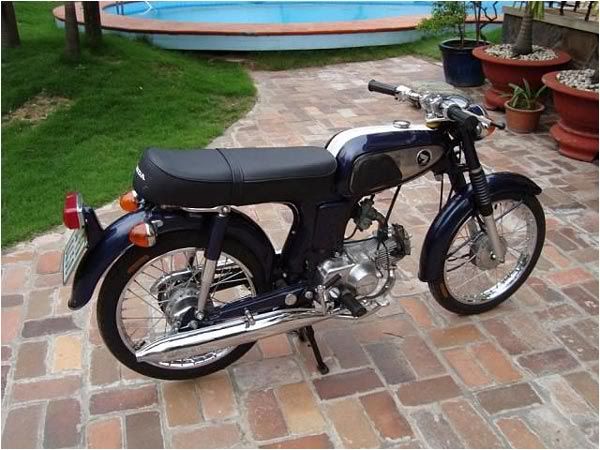
After the Vietnam War victory in 1975, Vietnam was in a process of rebuilding. People everywhere were stricken with poverty. Back then, only a select few could afford to buy a motorcycle. The most prominent motorcycle in Vietnam in the 1980s had to be the Honda SS50 (50cc) – commonly referred to as the Honda 67 because they were first manufactured in 1967. The SS50 was the motorcycle to have at that time and was considered a status symbol among the general population. “Players” (people who could afford to buy this motorcycle and modify it) held street races among themselves to see who had the best “67” and skills.
Honda SS50. Courtesy of Honda 67 Việt Nam.
After many years of dominance, the SS50 was dethroned by the Suzuki Sport 50 (50cc). This two-stroke monster could actually reach 120 km/h if “racers” who knew what they were doing put enough money in it. But its reign was short-lived because the tiny engine could not last long with such heavy modifications. The bright side is that they were very cheap to buy second-hand so more people could actually afford them later on.
Suzuki Sport 50. Courtesy of Báo Mới.
Then the Kawasaki Cosmo 105cc came into Vietnam from Thailand and completely destroyed the competition. The Cosmo had a much sportier look compared to the Honda SS50 or the Suzuki Sport and made a much better sound as well. If properly modified, it could reach speeds of 120 to 130 km/h. The Cosmo was favoured in the late-1980s, but in 1990 came the Suzuki Crystal 110cc which, once again, raised the bar. The Crystal was so strong that even with two people sitting on it, if the rider is not careful it would do a wheelie in first gear and throw the passenger off.
Kawasaki Cosmo. Courtesy of Thai Scooter.
Suzuki Crystal. Courtesy of 5 Giây.
In this period, the Crystal, especially the “Seven Star” variant, ruled the streets of Ho Chi Minh City and Hanoi and had a place in the hearts of all Vietnamese youths. Riding a Crystal with a girl as the passenger was what every high school and university students at that time wanted. If you rode a “C”, you had nothing and no one to fear. Shift down to first gear and accelerate and the people on the streets would all have to make way for you (and curse under their breath). Although speed-wise, it could not compete with the Honda Nova Dash (another two-stroke monster), but it was more expensive and elegant than the “Nova”. The “Nova” had a thuggish look that put off the girls and especially their parents. In the early-1990s, as the economy gets better and more people could afford motorcycles, four-stroke models were imported from Thailand. Honda became a household name with the Cub 50cc, Chaly 50cc and Dream II 100cc. Four-stroke motorcycles were heavily favoured over the two-strokes because of their reliability and fuel economy, especially the Dream II which was the new status symbol, costing roughly $1500 at a time when most households in the country did not make $500 a year. Coupled with the fact that criminals could finally get their hands on cheap throwaway two-stroke motorcycles and use them to terrorize the streets, the Crystals and Novas were seen as bad influence. But for racers, they were still gods among men compared to the tame four-strokes. The Suzuki Crystal can reach between 140 to 150 km/h when modified extensively and with a lighter rider, but because it was so light (less than 100 kg), its wind resistance was terrible. This was a major problem for anyone who wanted to race a Crystal because back then there was no such thing as motorcycling protective clothing or helmets in Vietnam so to fall off the motorcycle at those speeds would mean a sure death. Eventually, in 1994, the Suzuki Crystal and Honda Nova became less popular with racers even though later versions were more powerful and faster.
Honda Dream II. Courtesy of VnExpress.
The first racing-replica from Honda came into late 1994, the Honda NSR 150 (150cc). This motorcycle cost a fortune and was vastly more powerful than its competition. Ironically, that was exactly why it was not received favourably. It had no competition apart from itself and there were no point in racing it since victory was guaranteed. The NSR lived in obscurity for a while until the überexclusive Italian Cagiva Mito (125cc) arrived and “killed” it.
Honda NSR 150. Courtesy of Zing.
Cagiva Mito SP525. Courtesy of VnExpress.
But these racing replicas were not popular because they had no competition and were too expensive to run and maintain. Eventually, in 1995, the Suzuki Crystal reclaimed its throne as the most popular racing motorcycle in Vietnam. This was mostly because the 1995 version had a face-lift and featured a more aggressive front end (for that time). Its engine also remained the same so this newer Crystal had the same top speed as the older ones. This time, however, most garages focused on tuning for acceleration. If the rider is not used to its power, even in third gear it can still surge ahead unexpectedly and pull a power wheelie and throw them off. Even people with experience often find themselves sliding onto the back seat if they are not careful. Those who managed to hang on close their eyes and pray for the best.

The Suzuki Crystal was most popular in black because it was not available in many colours to begin with and also because black was the most unassuming colour and least likely to attract attention. 1996 was the end for the Crystal’s reign because another Suzuki was introduced into Vietnam: the RG Sport 110cc. This new motorcycle was more high-tech, faster and sportier than the dethroned Crystal. It also cost a lot more, even more than the 1996 Honda Dream II which cost approximately $2500, and most importers sold it for more than $3000. At the same time, Yamaha released the 110SS (also 110cc to compete with the RG Sport but it was not as well-known.

Suzuki RG Sport 110. Courtesy of BikePics
The earliest organized motorcycle races were held in Phú Thọ Province, Biên Hòa City and Cần Thơ Province. Suzuki and Yamaha were the two most competitive manufacturers. Even though it dominated the street racing scene, on the tracks, the 110SS gave the RG Sport a run for its money. As time went by, it was clear that the Yamaha was less reliable than the Suzuki. As a result, independent garages that ran the RG Sport won most races while only some veteran racers on the 110SS could salvage a few wins with technical help from Yamaha.
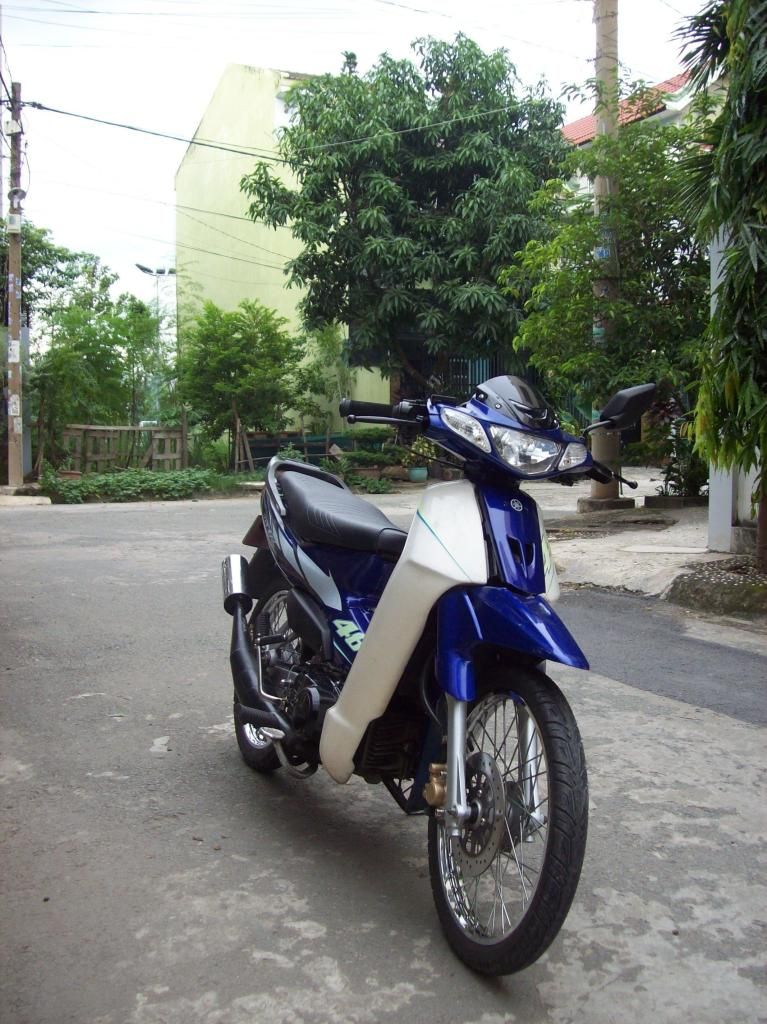
Yamaha 110SS. Courtesy of 5 Giây.
There is a good reason why Suzuki has garnered a huge following in Vietnam. Although the Vietnamese motorcycle market is now dominated by Honda and Yamaha, some still maintain that Suzuki makes the most underrated motorcycles. With the proper modifications and tuned for maximum speed, the RG Sport can reach 160 km/h. If tuned for acceleration, it will take a heavy rider (60-65 kg) to keep it from pulling wheelies in every gear. This motorcycle was also much better at cornering than its predecessor. The frame of the RG Sport was sturdy and felt very solid, its wheels were big and the tyres were higher-quality than those on the Crystal. It was so stable that a 40-degree lean angle was possible. If a rider attempts this on the Crystal, they will surely crash. 

The RG Sport was so favoured that everything associated with it was inflated. Decals and vinyls for this motorcycle cost about $25 – an absurd price at that time. In Ho Chi Minh City, numerous motorcycle accessories stores popped up and made fortunes by importing parts (pistons, air filters, bodyworks, big bore kits etc.) from Thailand, Indonesia and Malaysia.

In 1997, a four-stroke scooter arrived on the streets of Ho Chi Minh City: the Honda Spacy 125cc. It was purely a vehicle for the bourgeoisie. If you had a Spacy, you were upper-class. This was because it was much more elegant, easier to use and, generally speaking, cost a lot more than any motorcycle that was introduced before it. The Spacy gave Vietnamese motorcyclists a new perspective on motorcycle comfort and luxury, speed-wise it was no match for the two-strokes, but it was not fair to compare two different types of motorcycles made for different purposes. The only other mass-introduced motorcycle to rival the Spacy in price ($4500) was the new Suzuki RGV 120 (120cc). These two newcomers also helped the habit of Vietnamese from calculating prices of imported in 24K gold to using United States Dollar. This habit has persisted until today and is unlikely to go away anytime soon.
Honda Spacy 125. Courtesy of Mua Bán Xe Máy.
Suzuki RGV 120. Courtesy of Diễn Đàn Lê Quý Đôn.
After extensive modifications, the RGV 120 will reach more than 170 km/h, mostly 171-173 km/h. Some garages tune their motorcycles to get a maximum speed record will compromise the integrity of the engine and risk an engine failure to get to 180 km/h. However, these speeds can only be attained at the hands of an experienced and somewhat “mental” rider.

Towards the turn of the century, many more two-stroke as well as four-stroke motorcycles are introduced into Vietnam as the economy improves. Although all of them were fast for their times, the law has begun to crack down on illegal street racing and motorcycles have become a dominant form of transport in Vietnam, “racy” motorcycles such as the Suzuki Akira 110cc, the Honda Nova Dash 125cc or the Suzuki Stinger 120cc did not see much action.

Tuesday, 21 May 2013

The King of Vietnamese Silk

Nicknamed "The King of Vietnamese Silk", owner of a chain of uniquely impressive restaurants and ultra-luxury resorts, a self-made millionaire who built his empire with a string of successful multi-million-dollar investments, Mr. Hoàng Khải is a man of very fine taste. It comes at a price, however, as he believed himself to be a bad example when it comes to financial restraint. "Some times I say to myself that my taste for the finer things is too expensive," he once said jokingly.
Mr. Hoàng Khải. Courtesy of Giáo Dục.
This extravagance includes everything from food to real estate to automobiles. In 2007, a Rolls-Royce Phantom appeared out of nowhere and was parked in front of the Sheraton Hotel on Đồng Khởi Street in district One of Ho Chi Minh City. Immediately, the owner of this million-dollar-after-taxes car was none other than CEO and Chairman of the Board of the Khai Silk Group.At that time, his Rolls-Royce was regarded as the most expensive car in Vietnam.
Mr. Khải's Roll-Royce Phantom. Courtesy of VnExpress.
In the eyes of his employees, CEO Hoàng Khải is very friendly, open-minded and always wears a smile on his face. They even refer to him intimately as "World Peace" because he seems to bring a relaxed atmosphere with him wherever he goes.

Aside from his passion for silk from which he got moniker, Khải Silk reinforced his influence with successful ventures into real estate by building world-class resorts and restaurants. His first resort was opened in Hội An and was the first of its kind in Vietnam. It received the The Guide Awards for Best Boutique Resort in Vietnam in 2002. He also enlisted the help of Thủy Lộc Group to build Paragon - one of the most extravagant department stores in Vietnam. Paragon is situated in Phú Mỹ Hưng - an expensive residential area in district Seven of Ho Chi Minh City - and has 12 floors, four of which are for trading purposes. Paragon brought a new shopping experience to the Vietnamese upper-class consumers with its exclusivity.
"Just like with the Ming Dynasty restaurant, I didn't build it on the base of a antique house or villa. I built it from the ground up with a totally original idea. I believe it is more professional that way, and I am always professional in my work because it is what leads me to success," said Mr. Khải.
Hoi An Riverside Resort and Spa. Courtesy of Đô Thị.
Paragon. Courtesy of Zing.
Just recently, in 2012, his all-white castle - the Tamasago - made headlines around Vietnam because of its $15-million construction cost and the fact of it was built when all businesses are affected negatively by the global financial crisis. Mr. Khải revealed that after all his success, he thought it was only right if he aimed for the unthinkable. Besides, the purpose of his most recent creation is not just to reap profits, everyone - from the rich to the poor, from tourists to hard-working university students - is welcome for a visit. True, the leader of the Khai Silk Group has always believed that at the core of his success is his ability to immerse himself in the vibe of the people who surround him. "This isn't my personal castle. No, it stands here for anymore that can appreciate its beauty to see."
Tamasago. Courtesy of Nhóm Mua.
That maybe its core, but there is no denying that without his 17 years at the Ho Chi Minh City Conservatory of Music, he would not have made it to where he is today. According to the man himself, he was able to develop a keen sensitivity to arts and has utilized it from the first day he set foot in the business world. Whether he is designing fashion items or building restaurants, Mr. Khải pays careful attention to the details in order to cultivate the finest fibers of art and culture. This obsession with fine art and exotic cultures is reflected in his personal style and is also apparent in his every single creation.

When building the Au Manoir de Khai restaurant, he traveled to France extensively to soak in its culture. For the Ming Dynasty restaurant, he spent two years in China to learn everything from construction materials to interior design to their musical style. Even the terracotta warriors in the restaurant were actually transported from China to satisfy his desire for authenticity. Tourists from mainland China, Hong Kong, Singapore and Taiwan has commented that even in their country, such a feat is a rare sight. Perhaps out of appreciation for the neighbouring countries of Vietnam, he went on to build the Cham Charm restaurant. During the design phase, he spent hours observing sunset between to determine where it last rays light can be caught. "I tell people that the best time to visit my Cham Charm is between five and six in the afternoon," Mr. Khải said laughingly. "They should get the most out of what they pay because it certainly isn't cheap," he added after being inquired about the price range of his services.
Au Manoir de Khai. Courtesy of Sóc Bay.
Cham Charm. Courtesy of Việt Báo.
Ming Dynasty. Courtesy of Zing.
His resorts, however, are all located near beautiful sceneries. Their patrons can enjoy the sight of vast rice fields or rivers in which there are many farmers and fishermen doing what they do best. It is not an exaggeration to say that Khải Silk has turned Vietnam's countryside into an animated painting for his patrons to appreciate.

But Mr. Khải is not only a man of the present. He never forgets the roots of his success - the Brother's Cafe in Hanoi. Renamed Khai's Brother in 2009, this is the first of two Brothers with the second in Hội An. It is a renovated antique house where the Vietnamese culture is reproduced faithfully with food such as bánh cuốn, chả, phở etc. All the later restaurants have their own vibe, but what they all have in common is a faithful representation of culture, whether it is Vietnamese, French, Chinese or Cambodian. "If I hadn't studied music, I wouldn't have been able to capture every fabric of these cultures," he says constantly as if not to answer my questions but to remind himself.
Khai's Brothers. Courtesy of Chợ Điện Tử.
On his departure from music, Mr. Khải shared that his father was a musician and he had wanted him to follow in his footsteps. He did, but found that being successful in business was much more alluring, especially when his mother herself was a businesswoman - a rare case at the time. After a long pause, the man known as Khải Silk said proudly: "I am very lucky that both of them repects me enough to let me earn success with my own two hands."

Monday, 20 May 2013

Protecting a Dying Treasure

The Chinese Swamp Cypress is the only remaining species in the genus Glyptostrobus. Because of its extremely valuable decay-resistant and scented wood, this species has been threatened by overcutting to the brink of extinction. There are currently only two populations of this species in the world with a total of 166 specimens, four of which are in the Bank Hall Gardens in the United Kingdom and the remaining exists in the central-western highlands of Vietnam.
Furniture made of Chinese Swamp Cypress wood. Courtesy of Lao Động.
In the 1980s, within the Đắk Lắk province of central Vietnam, there was a lush forest of Chinese Swamp Cypress in the Ea Ral Commune. In order to build the Ea Ral Dam, the forest was cut down. At the time, the value of this particular tree was still unknown in Vietnam and the cutting proceeded without any obstruction.

In the years 2009 and 2010, the Chinese Swamp Cypress fever hit a record high and hundreds poured into Ea Ral to cultivate its wood. The baseless claims and superstitions of the wood’s ability to cure cancer and the collecting hobbies of the rich in Vietnam etc. made the protection of this tree extremely difficult and pushed it to near-extinction. Those who engage in this destruction include the poor who wished to change their lives by selling the wood and fear mongers who used their claims that the wood was divine to exploit the locals and uneducated people in Vietnam. Back then, there were only eight rangers in the Ea Ral forest. Thus, even though they have fought as hard as possible, their efforts were futile in the face of overwhelming opposition.

In December 2010, the University of Tây Nguyên investigated the forest to set up a preservation plan for the Chinese Swamp Cypress. They counted 255 specimens in the entire Đắk Lắk province. Of that number, the Ea Ral forest was home to 219, there were 31 in the Trấp K’Sơ forest in the Krông Năng district and 5 in the Cư Né forest in the Krông Buk district.
Specimen No. 26. Courtesy of Lao Động.
In January 2011, the People’s Committee of Đắk Lắk approved the preservation plan from 2010 to 2015. But it took more than 18 months to set up the legal parameters for the plan with the creation of the Department of Preservation of The Chinese Swamp Cypress. The aftermath of this delay was that 93 more trees had been but down, more than one-third of the total population in a very short amount of time. All five specimens in the Cư Né forest, ranging from 400 to 600 years old, were gone.

The Department of Preservation of The Chinese Swamp Cypress oversaw the protection of the Ea Ral forest. In March, they also took over the Trấp K’Sơ forest. Now, the total area for preservation is 120 ha (1.2 square kilometres) in which the core, with the highest density of Chinese Swamp Cypress, is 80 ha.
Mr. Trần Xuân Phước, director of the Department of Information Management from August 2012, confirmed that not a single specimen this cypress has been harmed since then. In the Ea Ral population of cypress, two guard stations were built in the centre of the forest. The rangers all had equal shifts and patrolled the forest 24/7, including weekends and national holidays. They also have guard dogs to assist during patrols and criminal pursuits.
A tent of the forest rangers. Courtesy of An Ninh Thủ Đô.
In the Trấp K’sơ population, the 21 trees stand scattered around an area of 40 ha so preservation work is more difficult. Chief Ranger Nguyễn Văn Khương confirmed that during night time, each round of patrol takes at least two hours, and especially on rainy nights, there will be two to three rounds of patrol. In this population, three specimens are particularly isolated so management recruited the assistance of three households with nearby properties in protecting them.

The greatest weakness of the preservation plan lies in its number of personnel. According to Mr. Trần Xuân Phước, only seven rangers are enlisted in the plan, three of whom are in managerial positions. In April, management enlisted four more rangers. Because of this, the workload is incredibly stressful for each ranger. They are not allowed to have time off unless it is absolutely necessary.
A confiscated vehicle carrying Chinese Swamp Cypress wood. Courtesy of Công An Nhân Dân.
In another effort to preserve this precious cypress, Professor Trần Vinh, Vice President of the Western Highlands Agro-Forestry Scientific and Technical Institute, has proposed that 1000 Chinese Swamp Cypress seeds will be planted naturally in Đắk Lắk from June 2013 to 2015. His proposal has been approved by the Department of Scientific Technology of Đắk Lắk.